
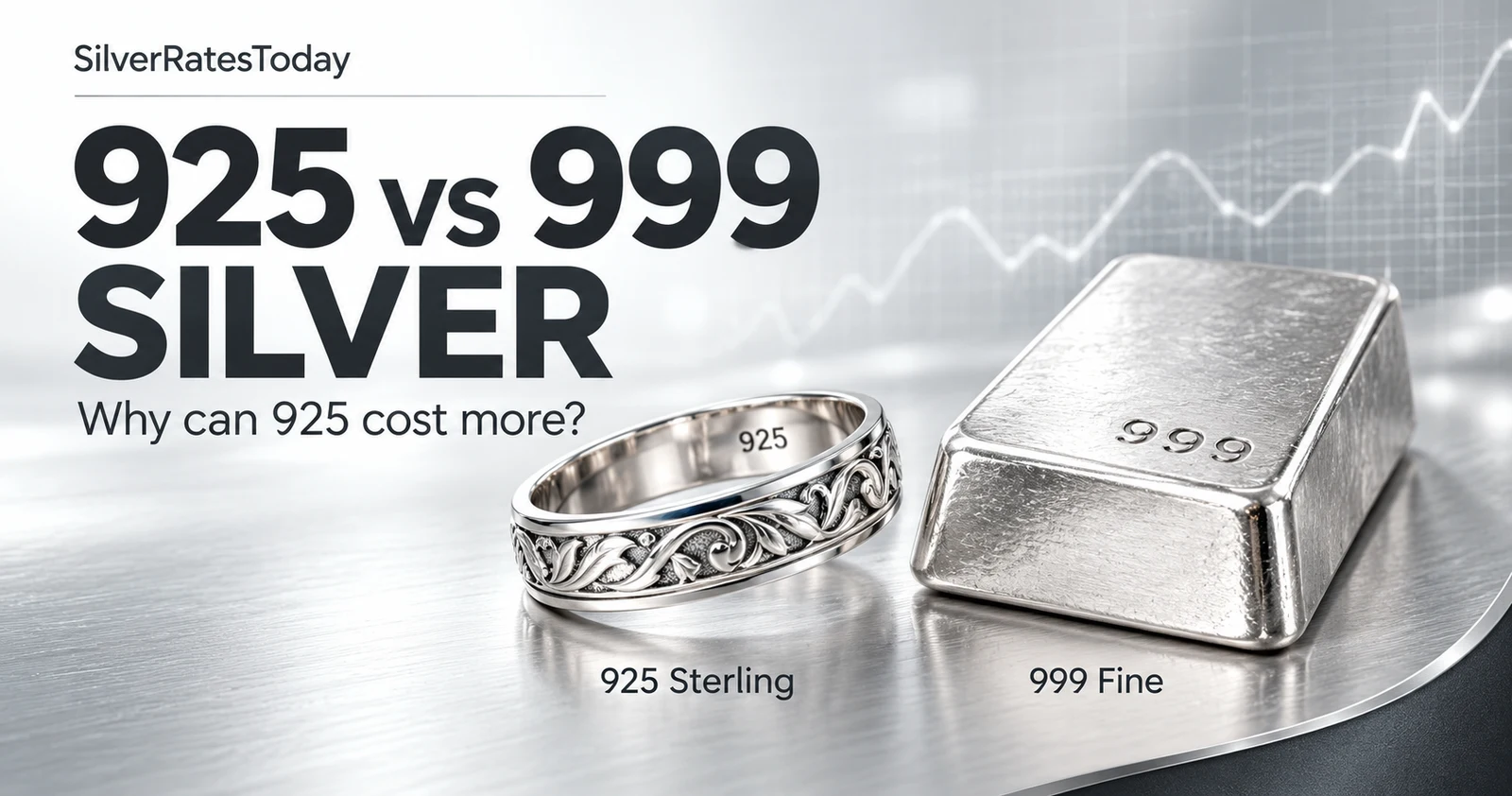
A 925 silver ring can cost more than a 999 silver bar of the same weight. So what are you actually paying for?
The main difference between 925 and 999 silver is purity. 925 contains 92.5% silver, while 999 contains 99.9%. Both are real silver when they meet those standards. But the final price also depends on what has been made from the metal.
Let’s break that down, starting with the numbers.
What do 925 and 999 mean?
The marks describe silver content in parts per thousand. Put more simply, they tell you how much of the metal is silver.
| Type | Silver purity | Silver in 100 g of metal | Remaining material |
|---|---|---|---|
| 925 sterling silver | 92.5% | 92.5 g | 7.5 g |
| 999 fine silver | 99.9% | 99.9 g | 0.1 g |
In 925 silver, the remaining 7.5% consists of other metals, commonly copper. A mixture of metals is called an alloy. The number does not tell you the complete mixture, so the other metal is not necessarily copper alone.
You may also see 999.9, which means 99.99% silver. The Royal Mint’s explanation of silver fineness describes how these numbers work.
These percentages mean the same thing in India, the US and the UK. Local hallmarking rules and buying costs can differ.
Why is 925 called sterling silver?
Sterling silver is the established name for the 92.5% silver standard. When a seller describes something as genuine 925 silver or sterling silver, they are usually referring to the same standard.
The word has historical links to British coinage. Its exact origin is uncertain, as the Royal Mint Museum explains.
Sterling describes the silver standard. It is not a brand name or a type of coating.
Why add other metals to silver?
Silver is naturally quite soft. That matters when you want a ring, chain or clasp to hold its shape through regular use.
Adding other metals can improve its strength and working properties. This helps explain why sterling is widely used for jewellery and silverware. The Royal Society of Chemistry describes silver’s softness and common uses.
999 silver is common in bars and bullion coins, although fine-silver jewellery exists too. Purity alone does not tell you how durable a finished piece will be. Its thickness, construction and intended use also matter.
Is 925 silver real or fake?
Genuine 925 silver is real silver. Being mixed with other metals does not make it fake.
The confusion often starts when 999 is described as pure silver. That can make 925 sound like an imitation, even though sterling is a recognised silver standard.
Silver plating is different. A silver-plated item has a layer of silver over another material. The US Federal Trade Commission distinguishes sterling silver from silver plate.
A 925 stamp can still be misused on an item that does not meet the claimed purity. So the standard is genuine, but a stamp alone does not prove that a particular item meets it.
How does purity affect the price of silver?
For the same metal weight, 999 contains more silver than 925. That gives it a higher silver-content value when both are calculated from the same underlying reference.
Let’s use ₹100 per gram before any purity adjustment as our reference. This is a hypothetical rate, not today’s silver price.
For 10 grams of metal:
| Calculation | 925 silver | 999 silver |
|---|---|---|
| Silver content | 10 × 0.925 = 9.25 g | 10 × 0.999 = 9.99 g |
| Silver-content value at ₹100/g | ₹925 | ₹999 |
The difference is ₹74, before making charges, premiums or tax.
At equal metal weights, 999 contains exactly 8% more silver than 925. That compares silver content, not the complete shop price.
Use the metal weight for this calculation. A ring weighing 10 grams with a stone does not necessarily contain 10 grams of silver alloy.
Why can 925 jewellery cost more than 999 silver?
Because you are also paying for a finished item.
A piece of jewellery can include design, making, finishing and the seller’s margin. A bar can carry its own manufacturing premium, as the Royal Mint explains in its bullion-pricing guide.
Now take our two 10-gram examples. Suppose the 925 ornament has ₹500 in making and design charges, while the 999 bar has a ₹100 premium.
| Price component | 10 g 925 ornament | 10 g 999 bar |
|---|---|---|
| Silver-content value | ₹925 | ₹999 |
| Making/design charge or premium | ₹500 | ₹100 |
| Total before tax | ₹1,425 | ₹1,099 |
The 925 ornament costs more even though it contains less silver. All these amounts are illustrative, not current quotations or typical charges.
When comparing quotations in India, check whether GST is included. Compare the same weight and purity, then look at the final amount payable.
How much am I paying for the silver, and how much for the finished piece? A clear price breakdown helps you answer that.
Does 925 silver have resale value?
Yes. Genuine 925 contains valuable silver, although less than the same weight of 999.
A resale offer depends on the accepted metal weight, tested purity, the buyer’s rate and any fees or deductions. There is no universal deduction percentage.
Making charges, packaging and brand premiums are not automatically recovered when someone buys an item for its metal content. Antiques and collectibles may also have value because of their maker, workmanship or rarity.
Ask the buyer to explain the calculation rather than comparing the offer only with your original bill.
Does silver turning black mean it is fake?
No. Silver can react with substances in the air and develop a dark surface. This is called tarnishing.
Sterling silver can tarnish, and fine silver can too. Darkening alone does not prove that an item is fake. A shiny appearance does not prove that it is 999 either.
If you need to establish purity, appropriate professional testing is more useful than judging the colour.
What should you check when buying silver in India?
Start with five things:
- Purity: What grade is claimed, and what supports it?
- Metal weight: Does the weight exclude stones and other non-silver parts?
- Rate: Is it quoted for the same purity and unit you are comparing?
- Final price: What making charges, premiums and taxes are included?
- Buyback terms: How would a future resale offer be calculated?
A bare 925 stamp is not the full BIS hallmark. Under the current HUID system, the silver hallmark includes the BIS mark with “SILVER”, the purity grade and a six-character HUID. The government’s silver-hallmarking explanation describes verification through the BIS Care app.
As of October 2026, silver hallmarking remains voluntary in India, while silver submitted under the BIS scheme must receive the HUID-based hallmark. An unhallmarked item is therefore not automatically fake. See the current BIS hallmarking brief.
Which should you choose: 925 or 999?
For jewellery you plan to wear, consider construction, comfort, design and the full price. For a bar or coin, compare silver content, authenticity, premium and buyback terms.
999 gives you more silver at the same weight. A well-made 925 piece can still be the more suitable item for your purpose.
To compare the numbers, check the silver-rate references for India and use the SilverRatesToday silver calculator. Select the same weight and market, then compare 925 with 999. Our calculation methodology explains the basis.
Compare that silver-content estimate with the complete shop quotation. You can then see what the silver contributes to the price and what you are paying for the finished piece.