
999 Fine Silver
Per Gram2.47AUD-0.01 -0.43%
Per Kilogram2,475AUD-10.69 -0.43%
Per Troy Ounce76.97AUD-0.33 -0.43%
Check silver prices in Australian dollars per gram, kilogram and troy ounce. The AUD reference combines international silver and exchange rates; calculate 999 or 925 silver value before dealer charges and taxes.
Track live silver price movement on the chart and compare recent daily rates in one clean view.
Connecting to live historical data…
Verified chart data is loading…
| Date | 999 / G | 925 / G | Daily Change |
|---|---|---|---|
Loading recorded daily prices…
UTC dates. Daily change compares the previous day's recorded reference; today's value updates live.
See the recorded move, the local currency or benchmark effect, and possible influences from dated market reporting.
Recorded changes and measured local effects are shown separately from possible influences in the reporting. A shorter observed change shows its actual duration. Context explains how a factor could affect silver; it does not prove the cause of the displayed move.
 Analysis
More silver imports could ease local premiums in India, but international prices, the rupee and product charges still shape the final bill.
Read analysis →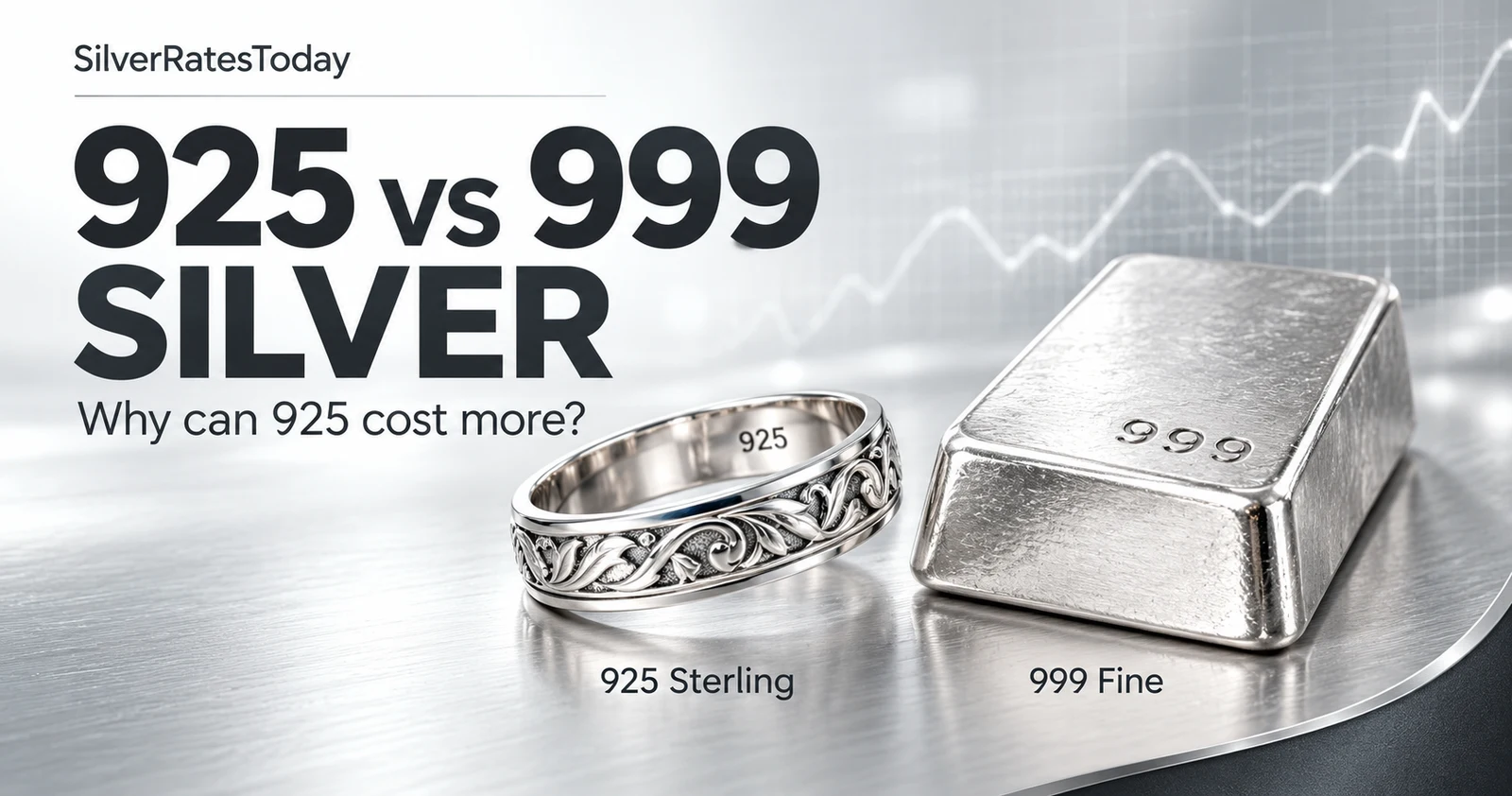 Insight
Understand what 925 and 999 mean, how purity affects silver value, and why 925 jewellery can still cost more than a 999 bar.
Read insight →Comparing gold and silver as investments in 2026. Find out the key differences, the gold-silver ratio, and which metal suits your investment goals.
Read insight →SilverRatesToday shows regularly updated silver-price references for the selected market and currency. We use international and relevant market data, check the readings, and calculate prices for different weights and purities. These figures help you compare silver prices and estimate metal value. They are informational references; the price a dealer offers can be different.
999 fine silver contains 99.9% silver, while 925 sterling silver contains 92.5% silver. The remaining content consists of other metals; these make sterling silver more suitable for items that need greater strength, such as jewellery.
For example, a 100-gram item of 999 silver contains 99.9 grams of silver, while a 100-gram item of 925 silver contains 92.5 grams. Our purity comparisons reflect this difference in silver content, rather than the craftsmanship or resale value of a finished item.
Enter the weight, then choose the unit, currency and purity. The calculator converts the weight where needed and estimates the value of the silver content using the selected price reference.
For example, if the underlying silver reference before purity adjustment were US$2 per gram, a 10-gram item of 925 silver would have an estimated silver-content value of:
10 × US$2 × 0.925 = US$18.50
This is a hypothetical example, not a current price. The calculator gives a metal-value estimate, rather than a dealer’s buying or selling offer. The Methodology page explains the calculation in more detail.
Silver prices respond to changes in supply and demand. Demand comes from both investment and industrial uses, including electronics and solar panels. Changes in manufacturing activity, investor interest, interest-rate expectations and economic conditions can influence the market.
Exchange rates also matter when prices are shown in another currency. A local-currency price can change even when the underlying international silver price stays the same. Several factors can act together, so a news headline alone does not establish why a particular price moved.
No. The displayed rates estimate the value of the silver itself and exclude dealer premiums, taxes, making or minting charges, shipping and other transaction costs.
A bar, coin or piece of jewellery can cost more because its price includes costs beyond its silver content. A dealer’s purchase offer can also differ because of testing, refining costs, margins and the spread between buying and selling prices. Confirm the full quote and applicable charges with the seller or buyer before a transaction.
Prices are available in USD, INR, AED, AUD, GBP, CAD and SGD, with options for grams, kilograms and troy ounces. You can also compare 999 fine silver with 925 sterling silver.
One kilogram equals 1,000 grams, and one troy ounce equals 31.1034768 grams. A troy ounce differs from the ordinary ounce used for everyday weights. When comparing prices, use the same currency, unit and purity.
We refresh the price information regularly, but silver-market references and exchange rates follow different publication schedules. A website refresh does not necessarily mean the underlying market price has changed.
“Price observed at” identifies the time associated with the price reading. “Last refreshed” shows when the website last refreshed that information. Read both together to understand how recent the displayed figure is.
A reference can remain unchanged when no new reading has been published, including outside its normal market or publication hours. Data delays or a reading that fails our checks can also interrupt an update.
When a refresh fails, the website can retain the last usable reading with its timestamp or show that the information is unavailable. An unchanged value does not always mean the market was inactive, and an unavailable value does not mean silver has no value.
The two figures compare different periods. The daily table uses UTC dates and compares each date’s recorded value with the previous date’s value. Today’s row uses the latest available reading; earlier rows use the last recorded reading for that date.
A 24-hour change compares observations approximately 24 hours apart, rather than following the UTC date boundary. The percentages can therefore differ without either being incorrect. The daily-table observations are not official market closing prices, and a missing comparison is not treated as a zero change.
The charts show recorded silver prices and historical data for the selected currency and period. Longer India and UK charts can include estimated values for dates without local records; recorded local prices replace those estimates as data becomes available. The Methodology page explains this calculation and its limitations.
For more detail, see our Methodology. Questions or suspected errors can be sent to silverratestoday@gmail.com.
SilverRatesToday provides information and estimates, not personalised financial or investment advice.